Posts

Showing posts with the label Anglican History

Saint Alban

Image
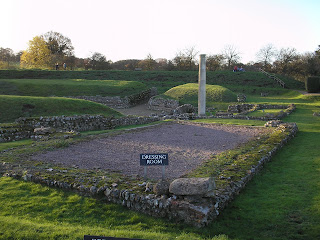
Today on some calendars is the Feast Day of Saint Alban, reputedly the first Christian Martyr in England. Saint Alban is mentioned in "Acta Martyrum", and also by Constantius of Lyon in his Life of St Germanus of Auxerre, written about 480.What we know of Alban also comes from the history of the Venerable Bede who died circa AD 735. Alban lived in the Roman period in Britain in a town called Verulamium, near the current Cathedral of St. Albans north of London. The ruins have been excavated. I visited them some years ago when I was living in England. Archaeology being a hobby of mine, I and have some pictures: Mainly what you are seeing is the Roman earthen amphitheater. Closer to St Alban's Cathedral, you can still see some of the original Roman walls: (I had more hair back then...)  Of course, there is St. Alban's Cathedral itself, which is quite lovely : Most know the Christian story of Alban by Bede, which is worth a re...

Prayerbook Preface, Pt. III

Continuing on through the first paragraph of the original preface to the Book of Common Prayer, we read (emphasis mine): "There was never any thing by the wit of man so well devised, or so sure established, which in continuance of time hath not been corrupted: as, among other things, it may plainly appear by the common prayers in the Church, commonly called Divine Service: the first original and ground whereof, if a man would search out by the ancient fathers, he shall find, that the same was not ordained, but of a good purpose, and for a great advancement of godliness: For they so ordered the matter, that all the whole Bible (or the greatest part thereof) should be read over once in the year, intending thereby, that the Clergy, and  especially such as were Ministers of the congregation, should (by often reading, and  meditation of God's word) be stirred up to godliness themselves, and be more able to exhort  others by wholesome doctrine, and to confute them that were ...

Prayerbook Preface, Part I

I have been promising for some weeks to do a series on the Preface to the First Book of Common Prayer. I have been researching that topic, but then I hit vacation and &c., and have not gotten around to posting on this yet. I am about to remedy that now.  Before I get into that, a little preface on the Preface might be in order. We, Episcopalians, take the Book of Common Prayer for granted. As is common in most Church life, the things we do, we often do without really stopping to think why we do things a certain way. "We've always done it this way!" In some ways, this is actually a true statement, at least as it pertains to how worship came to be governed in what became the Church of England via the English Reformation and the Church of England's theological descendants like the Episcopal Church in the USA. The Book of Common Prayer was the brainchild of a man named Thomas Cranmer. I have written on this before at some length. (I was halfway through seminary b...

The Original Preface to the Book of Common Prayer

I have gotten some interesting feedback for idea topics from my query yesterday on what to do for a new series of blog entries, now that I have finished my 39 Articles in 39 days series. A commentary on the "Tracts for the Times" which spawned the Tractarian movement in the early 1800's was suggested on Facebook. Other suggestions were to compare and contrast the Canons of the Mass between the BCP and the Novus Ordo. Both of those ideas interested me, but both are some heavier duty academic lifting that I do not have time to engage in at the moment.  My wife also suggested doing a Saint of the Week commentary, which I may do in addition to a longer series.  I have to figure out what saint to pick from. I, personally, refuse to use that new Holy Women, Holy Men monstrosity (or as I refer to it, Holy Women, Holy Weirdos ) that General Convention is trying to foist on us because it is just any and every "saint" that someone somewhere wanted to add to the calend...

Article 38: Goods Held in Common

Today's article (We are nearing the very end!) deals with the interesting theological concept of things held in common by the community:  XXXVIII. Of Christian men's Goods, which are not common The Riches and Goods of Christians are not common, as touching the right, title, and possession of the same, as certain Anabaptists do falsely boast. Notwithstanding, every man ought, of such things as he possesseth, liberally to give alms to the poor, according to his ability. This article clearly calls out the Anabaptists by name. Anabaptist, of course, is an umbrella term for quite a few strands of Radical Reforming Protestantism. I have gone into this discussion before. I will only note that one should be sure not to confuse the term Anabaptist with Baptist, as the two are completely different. Most known of the Anabaptists in America are the Amish, Mennonites, and Hutterites. I mention the Hutterites because there are several Hutterite colonies in South Dakota. In fact, th...

37 down, 2 to go

I am nearing the end of the blog series on the Articles of Religion. There are only two more after today. Today's is a piggyback on yesterday's article concerning the legal and proper procedure for the Consecration of Bishops. Today's article is cut of the same cloth, but in the civic realm: XXXVII. Of the Civil Magistrates The King's Majesty hath the chief power in this Realm of England, and other his Dominions, unto whom the chief Government of all Estates of this Realm, whether they be Ecclesiastical or Civil, in all causes doth appertain, and is not, nor ought to be, subject to any foreign Jurisdiction. Where we attribute to the King's Majesty the chief government, by which Titles we understand the minds of some slanderous folks to be offended; we give not our Princes the ministering either of God's Word, or of the Sacraments, the which thing the Injunctions also lately set forth by Elizabeth our Queen do most plainly testify; but that only prerogative, ...

Article 36: On Consecration

Now we start getting into the legal domain of the Articles of Religion. None of this is particularly of thrilling theological stuff, but it is interesting in terms of Anglican history.  XXXVI. Of Consecration of Bishops and Ministers The Book of Consecration of Archbishops and Bishops, and Ordering of Priests and Deacons, lately set forth in the time of Edward the Sixth, and confirmed at the same time by authority of Parliament, doth contain all things necessary to such Consecration and Ordering; neither hath it any thing, that of itself is superstitious and ungodly. And therefore whosoever are consecrated or ordered according to the Rites of that Book, since the second year of the forenamed King Edward unto this time, or hereafter shall be consecrated or ordered according to the same Rites; we decree all such to be rightly, orderly, and lawfully consecrated and ordered. One will notice in the 1979 American Book of Common Prayer that this one is altered entirely. The Am...

Article 35: More "Understanded of the People"

Today's article is one that the American prayerbook tradition has always either rewords or added some manner of Roger Maris asterisk to:     XXXV. Of the Homilies The second Book of Homilies, the several titles whereof we have joined under this Article, doth contain a godly and wholesome Doctrine, and necessary for these tunes, as doth the former Book  of  Homilies, which were set forth in the time  of Edward  the Sixth; and therefore we judge them to be read in Churches by the Ministers, diligently and distinctly, that they may be understanded  of  the people. Of the Names of the Homilies 1. Of the right Use of the Church 11. Of Alms-doing 2. Against peril of Idolatry 12. Of the Nativity of Christ 3. Of repairing and keeping clean of Churches 13. Of the Passion of Christ 4. Of good Works: first of Fasting 14. Of the Resurrection of Christ 5. Against Gluttony and Drunkenness 15. Of the worthy receiving of the Sacrament of the...

Article 34:

Today's article is pretty stock Anglican Common Prayer doctrine: XXXIV. Of the Traditions of the Church It is not necessary that Traditions and Ceremonies be in all places one, and utterly like; for at all times they have been divers, and may be changed according to the diversities of countries, times, and men's manners, so that nothing be ordained against God's Word. Whosoever through his private judgement, willingly and purposely, doth openly break the traditions and ceremonies of the Church, which be not repugnant to the Word of God, and be ordained and approved by common authority, ought to be rebuked openly. (that others may fear to do the like,) as he that offendeth against the common order  of  the Church, and hurteth the authority of the Magistrate, and woundeth the consciences  of  the weak brethren. In other words, the Anglican Church does not have to follow the liturgical uniformity that Rome or Orthodoxy imposes, and yet we do so writ small . An...

Article 33: Excommunication

Today's article is something that I think the modern Church might well consider re-applying to today's world. XXXIII. Of excommunicate Persons, how they are to be avoided That person which by open denunciation of the Church is rightly cut off from the unity of the Church, and excommunicated, ought to be taken of the whole multitude of the faithful, as an Heathen and Publican, until he be openly reconciled by penance and received into the Church by a Judge that hath authority thereunto. The Episcopal Church's current mantra is "radical inclusiveness." I do not claim to support, or even fully understand, what exactly this terms means. Frankly, I recoil from buzzwords like this because I find them simplistic sloganisms that are self-congratulatory to the point of being patently self-righteous. My other pet peeve is the one about 'Episcopalians don't check their brains at the door,' the logical inference being that other Christians are just ignorant ...

Article 25: Of the Sacraments

Today's article is one of the longest in the Articles of Religion. I am not sure word count wise, but it certainly has the most paragraphs.  So, marching headlong into the issue of Sacraments: XXV. Of the Sacraments Sacraments ordained of Christ be not only badges or tokens of Christian men's profession, but rather they be certain sure witnesses, and effectual signs of grace, and God's good will towards us, by the which he doth work   invisibly in us, and doth not only quicken, but also strengthen and confirm our Faith in him. There are two Sacraments ordained of Christ our Lord in the Gospel, that is to say, Baptism, and the Supper of the Lord. Those five commonly called Sacraments, that is to say, Confirmation, Penance, Orders, Matrimony, and extreme Unction, are not to be counted for Sacraments of the Gospel, being such as have grown partly of the corrupt following of the Apostles, partly are states of life allowed in the Scriptures; but yet have not like nature...

Article 24: "Not Understanded by the People"

Today's article was indeed revolutionary at the time: actually saying the church service in a language people understood and not Latin. XXIV. Of speaking in the Congregation in suck a tongue as the people understandeth It is a thing plainly repugnant to the Word of God, and the custom of the Primitive Church, to have publick Prayer in the Church, or to minister the Sacraments in a tongue not understanded of the people. I would quibble with whether such a notion is truly repugnant to the Word of God. I cannot think of any verse of scripture that clearly says, "Thou shalt say clearly say a church service in the vernacular." Paul does speak to the issue of the speaking in tongues, but whether he was referring to the gift of linguistics or the modern Pentecostal glossolalia is somewhat debatable. But regardless, he does say "in the church I had rather speak five words with my understanding, that by my voice I might teach others also, than ten thousand words in an u...

Article 23: Who Is Called?

Today's article, though sadly misused to punish and abuse dissenters and non-jurors in the history of England, has a good bit of wisdom to it: XXIII. Of Ministering in the Congregation It is not lawful for any man to take upon him the office of publick preaching, or ministering the Sacraments in the Congregation, before he be lawfully called, and sent to execute the same. And those we ought to judge lawfully called and sent, which be chosen and called to this work by men who have publick authority given unto them in the Congregation, to call and send Ministers into the Lord's vineyard. This article likely makes Americans somewhat uneasy, given our penchant for wanting to shoot our mouths off whenever we feel like it. Freedom of Speech is a right, and a good one at that. However, the Church is different than civic society. When ministers speak, they speak both for God and the larger Body of Christ. As such, there is a process in most denominations (usually referred to as...

Article 22: 'Of Romish Doctrine'

Image
Today's Article does not get more Anti-Catholic and Anti-Eastern Orthodox than this: XXII. Of Purgatory The Romish Doctrine concerning Purgatory, Pardons, Worshipping and Adoration, as well of Images as of Reliques, and also invocation of Saints, is a fond thing vainly invented, and grounded upon no warranty of Scripture, but rather repugnant to the Word of God. So, in one swoop, the Anglican church bemoaned the manifold sins and wickedness of the doctrines of Purgatory, Pardons (and indulgences which we have already discussed), and Worshipping and Adoration of Icons and Holy Relics and the broadly vague "invocation of Saints."  That is so broad a swath of theological topics that Puritans were obsessed with that I am not sure where to begin. I suppose going in order is the best manner. So, batting lead off: Purgatory . This is a particularly vexing doctrine for many Protestants, and I think also for some Catholics because the Church mishandled the teaching of it o...

Article 21: Blackjack!

As usual, today's article is an interesting amalgam of Anglican heritage(s). It is very politely anti-Papal authority and anti-Catholic Holy Tradition. It is also very politely insinuating that the King is the head of the Church and that councils can err since they are made up of humans who err. Here is today's Article portion: XXI. Of the Authority of General Councils General Councils may not be gathered together without the commandment and will of Princes. And when they be gathered together, (forasmuch as they be an assembly of men, whereof all be not governed with the Spirit and Word of God,) they may err, and sometimes have erred, even in things pertaining unto God. Wherefore things ordained by them as necessary to salvation have neither strength nor authority, unless it may be declared that they be taken out of Holy Scripture. Being an American who values the logic in the secular philosophy of "separation of Church and State," I have trouble with the first ...

Article XX: Of the Authority of the Church

Today's article is a relevant now as it was when it was adopted. Protestants have always wrestled with the issue of Authority. This is only more true now than it was then because we live in a  flauntingly  individualistic society where the cry of the age is "How dare you tell me anything about what I should believe or do with my life!?!" Again, this section has to do with the Authority of the Church, stemming from reactions against Roman Catholic hierarchy and the Pope: XX. Of the Authority of the Church The Church hath power to decree Rites or Ceremonies, and authority- in Controversies of Faith: And yet it is not lawful for the Church to ordain any thing that is contrary to God's Word written, neither may it so expound one place of Scripture, that it be repugnant to another. Wherefore, although the Church be a witness and   a keeper of Holy Writ, as it ought not to decree any thing against the same,   so besides the same ought it not to enforce any ...